Midwest grazing Exchange and Non-Traditional Sampling
November 13, 2020
Midwest Grazing Exchange
In the past, you may have read about incorporating livestock back onto to our soils to help build soil health. The lack of livestock on most area farms is an obvious hurdle to overcome. We have removed a critical part of the soil health equation that helped to form our soils in the past. However, there is a new service that helps to bring livestock back onto your land. The Midwest Grazing Exchange is a new website that matches farmers with forage resources with the farmers that have livestock. This is a free matchmaking service that hopes to connect grazers and landowners. The website allows users to create listings of what land or livestock they have, to see examples of grazing lease agreements, and search for specific grazing types or livestock. If you are interested in this service, the website link can be found in the Resources section below. This service could
be a great way to add value to your cover crops or other grazing lands.
Non-Traditional Sampling
Every standard soil test we run provides gives a wealth of information for each zone sampled. The list includes water pH, buffer pH, Organic Matter, Exchange Capacity, % base saturation of cations, and Mehlich III extractable amounts of 12 elements: Ca, Mg, K, Na, P, S, Mn, Zn, B, Cu, Fe, and Al. We can schedule additional tests for less common micronutrients besides those listed, if requested.
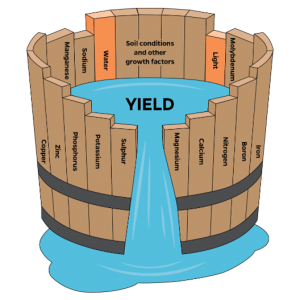
Aside from traditional soil sampling, other kinds of sampling / tests can help to provide additional insight into your operation to help you drive informed decisions, not just guesses. Below are a few of the many tests available.
An irrigation water test shows the make-up of your irrigation water. Different water sources can strip nutrients (make them available) or bind nutrients (make them unavailable) to soil particles. Sources that tend to bind could be counteracting the benefits of the irrigation water th at applied to our fields. If you have noticed performance of irrigated fields stopping at a level rather than climbing as high as you would expect, have us test your water. This information will help determine if a water source or field needs to be treated. Pairing the water test with a saturated paste test will show nutrient availability when the specific water and soil sample interact in a particular field based on the chemical makeup of the combination.
Starting last year, we began offering a DNA analysis service through Pattern Ag whic h can “fingerprint”, or identify organisms found in a soil sample through their DNA make up. With this you can manage around the potential disease pressures from bacteria, fungi, and viruses that over winter in fields. The test can also identify soil microbes that are beneficial. The DNA data can be used in trait selection and to better place hybrids or varieties based on the issues that could be a problem in the field. The tool could be very beneficial for driving input decisions or knowing what areas you need to keep a closer eye on.
The soil health test (SHT or Haney test) is a test that utilizes a weak acid extraction method that more closely mimics nutrient uptake by plant roots. The test also grades our soil based on the water extractable organic carbon and nitrogen that increase with higher mi crobial activity. The tool is excelle nt for benchmarking our soils as we add in practices like no-till or cover crops. Some farmers are using this to stand out to potential landlords and how they manage the land.
These are just a few of the tests available to you. If you would like to discuss tests not mentioned in this list, please reach out. Learning what is going on in your fields will give you information to assess the performance you are experiencing. There is a wide range of tests from the pre-side-dress nitrate test (PSNT) to soybean cyst nematode (SCN) testing that can help you make informed production decisions. Use these tools available to unlock your yield potential. The more you know, the more you grow!
Resources
The post Midwest grazing Exchange and Non-Traditional Sampling appeared first on Greene Crop Consulting.